

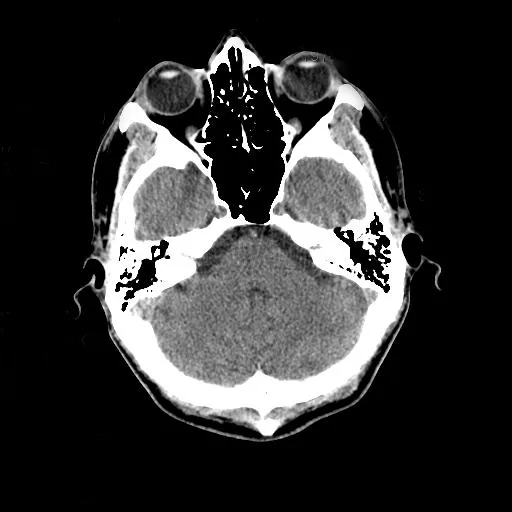
 In some cases, patients sustaining trauma to the head and neck area will have both closed head injuries and maxillofacial trauma. Of the two, closed head injuries are more severe and need to be managed before the maxillofacial trauma is treated. Patients with closed head injuries can have intracerebral hematomas, subdural hematomas or epidural hematomas. Each of these blood clots can increase in size and can cause excess pressure on the brain. This can lead to semiconscious states or coma and, in severe cases, they can cause herniation of brain tissue through the foramen magnum at the base of the brain. Such a condition is almost uniformly fatal because the patient is unable to breathe on their own and have instability of pulse and blood pressure.
The recommendation of most physicians who suspect an intracranial injury when a maxillofacial injury is noted gives the patient a CT scan of the head and face. This CT scan will determine the presence of bleeding, swelling and blood clots in the brain and will demonstrate any skull fractures or facial fractures. When the brain is stabilized through surgery or other modality, then the maxillofacial fractures, contusions, and lacerations can be managed secondarily.
How many patients with maxillofacial injuries actually sustain cranial injuries on top of facial injuries? One study looked at a hundred closed head injuries associated with the presence of facial fractures that were treated at a Level 1 trauma facility over a seventy-eight (78) month period. The facility was located in Northeastern Ohio. It was found that approximately 17.5 percent of patients with facial fractures also had closed head injuries. Males sustained closed head injuries four times more often than women with an age group predominance of about 16-30 years of age. About 59 percent fell into this age group. The most common cause of injury was a motor vehicle accident at 61 percent. While most injuries were sustained due to auto accidents, motorcycle accidents resulted in the most severe cases of head injury. There were more mandible fractures when compared to maxillary fractures with a ratio of 1.3 to 1. Facial fractures were found to have a similar incidence as in the non-head injured population at 14 percent but were associated with more severe intracranial injuries.
There is a greater chance of traumatic skull injuries when the facial fracture is closest to the skull. For example, if the maxilla or frontal bone is fractured, it can more easily extend up or back to include a fracture of the cranial bone. If the jaw is injured, there is less of a chance that the skull will be fractured, too. If a maxillofacial injury results in severe blunt trauma to the head, it can cause similar blunt trauma to the brain; brain injury is the result.
The combination head injuries and facial injuries which are severe and often require a team of neurosurgeons, ENT doctors, plastic surgeons, and maxillofacial surgeons to take care of the head injury first, followed by any facial bone fracture and any facial soft tissue injury.
Of primary importance to those who suffer such severe injuries is their health. If you wish to alleviate the stress of your claim while recuperating from a severe injury, feel free to contact Edward A Smith Law Offices (www.AutoAccident.com) to assist you. The toll-free number is (800) 404-5400.
Photo Attributed to Andrew Ciscel (Flickr) [CC-BY-SA-2.0 (http://creativecommons.org/licenses/by-sa/ via Wikimedia Commons)